
Against "Abundance™"
Towards a New Civic Religion

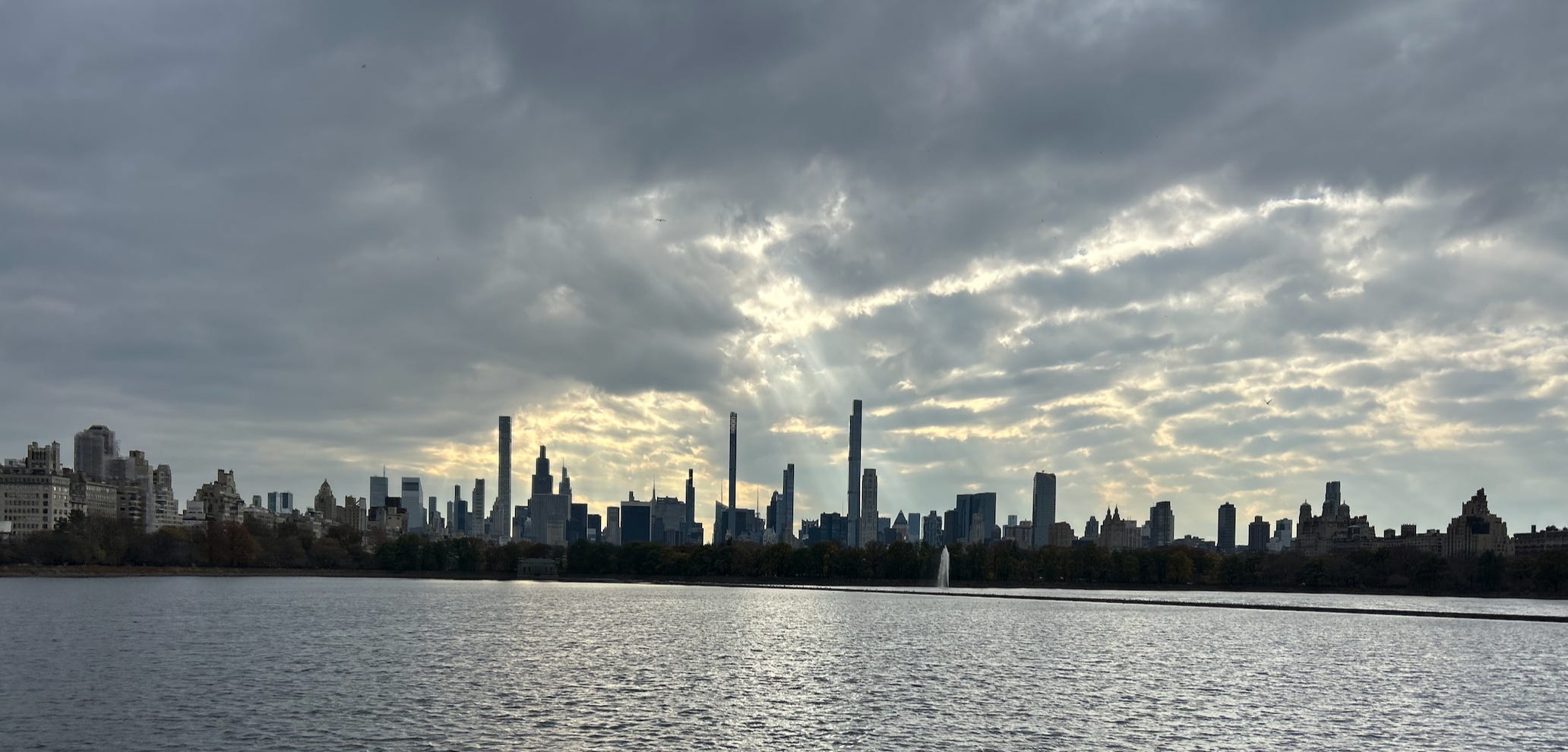
Many YIMBY and Abundance-minded folks will tell you that New York City can’t build big things anymore. Of course, the city is just completing construction of one of the largest water tunnels in the world (admittedly, six decades is a long time, but then, shouldn’t our cities be planning and building on the multi-decadal and century-plus time horizon?); has poured tens of billions into resilience and coastal defense since Superstorm Sandy hit in 2012; and has dramatically transformed much of its waterfront – through the construction of extensive new parkland, promenades, bike paths, etc. – a transformation which has gone hand in hand with a staggering building boom (mostly of luxury condos) from the South Bronx to Long Island City, Downtown Brooklyn to Williamsburg, and all across the island of Manhattan, but nowhere more so than along the Hudson River on the west side. The Greenmarkets are new (1975). Citi Bike is new (2013). The NYC Ferry system (money pit that it is) is new (2017). The Navy Yard, Governor’s Island, the Brooklyn Army Terminal, and Roosevelt Island are all undergoing profound transformation/revitalization, with (climate) tech hubs emerging/having emerged on each over the past decade or so. And six of the ten tallest buildings in the Western Hemisphere have been completed in New York in the last 10 years (with One World Trade Center, a seventh, completed in 2014, the same year that the then-largest and most advanced MRF in the Americas came online in Sunset Park). I list not to attempt to be comprehensive, but off the top of my head, and to lay bare the absurdity of the claims of these doomsayers. New York has continued, and I expect will continue to do all sorts of big things, both directly as city government, and through public-private partnership and via its dynamic private sector.
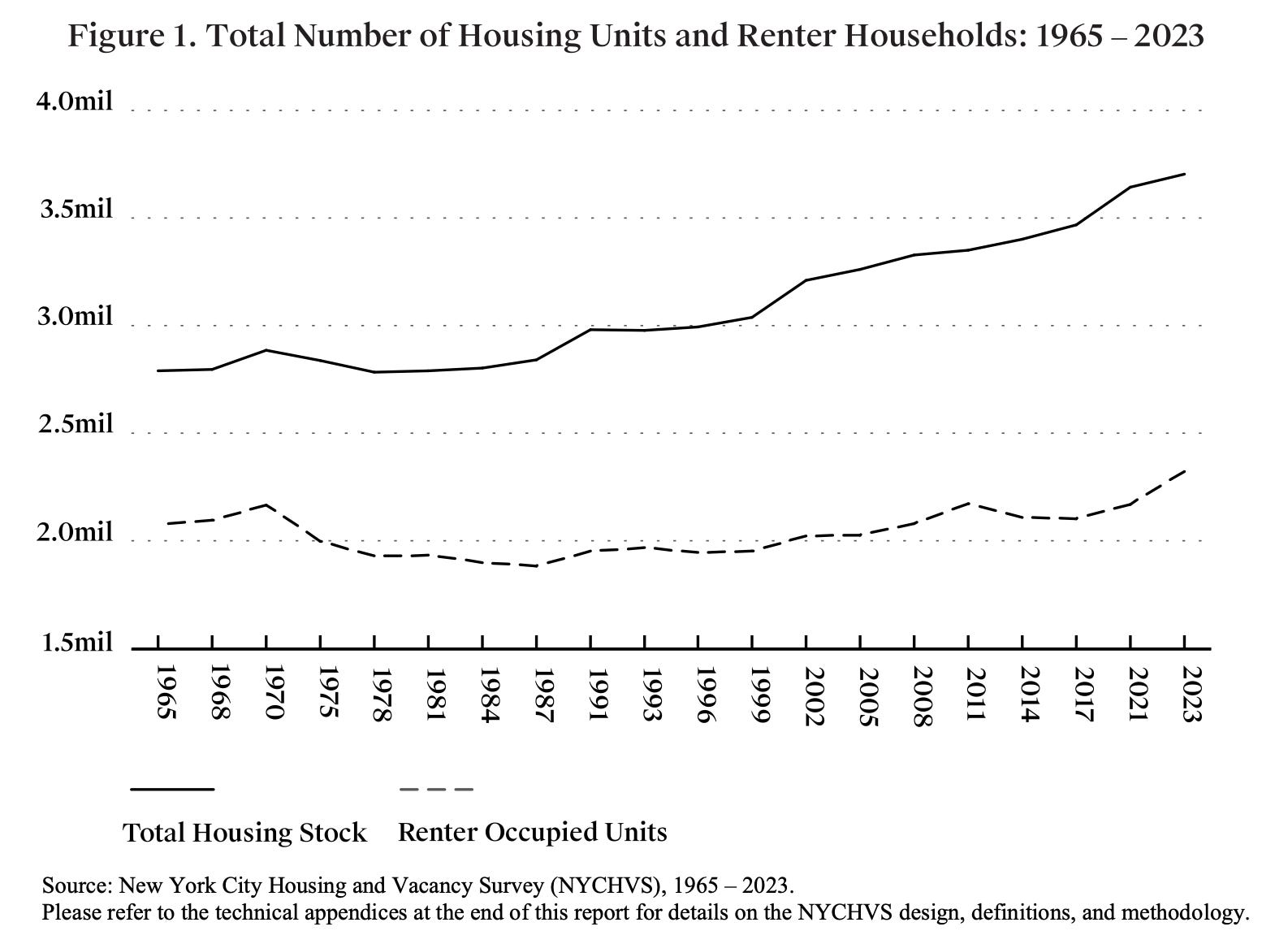
Chief among the claims of the doomsayers is that New York City doesn’t build housing anymore, although the city’s own numbers will, of course, contradict that assertion.
Here’s what the city’s population did over approximately the same time period (with numbers drawn from here and here, and 2022 figure used to avoid 2020 pandemic-related discrepancies):
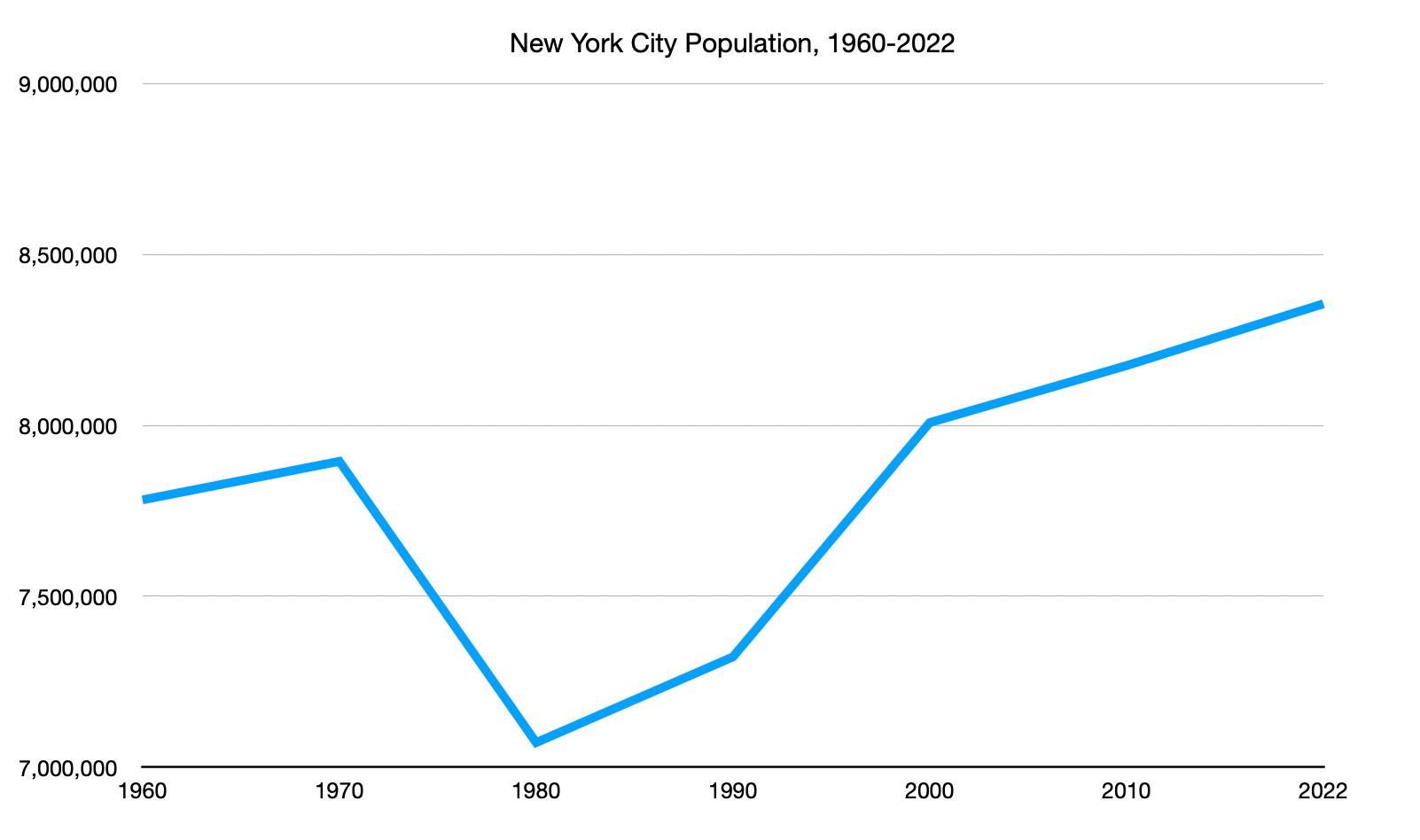
Kind of weird, right, when you actually think about it? A steady increase in housing stock outpacing growth in population, and yet the primary refrain is that there is not enough building going on in New York?
I’ll come back to this, but to persist for a minute, the doomsayers will point to the fact that we can’t build subway tunnels anymore, and when we do, it is inordinately expensive, and on that point, they will be largely correct, and yet, doesn’t the New York City Subway system still carry more riders than any other metro system in the US?
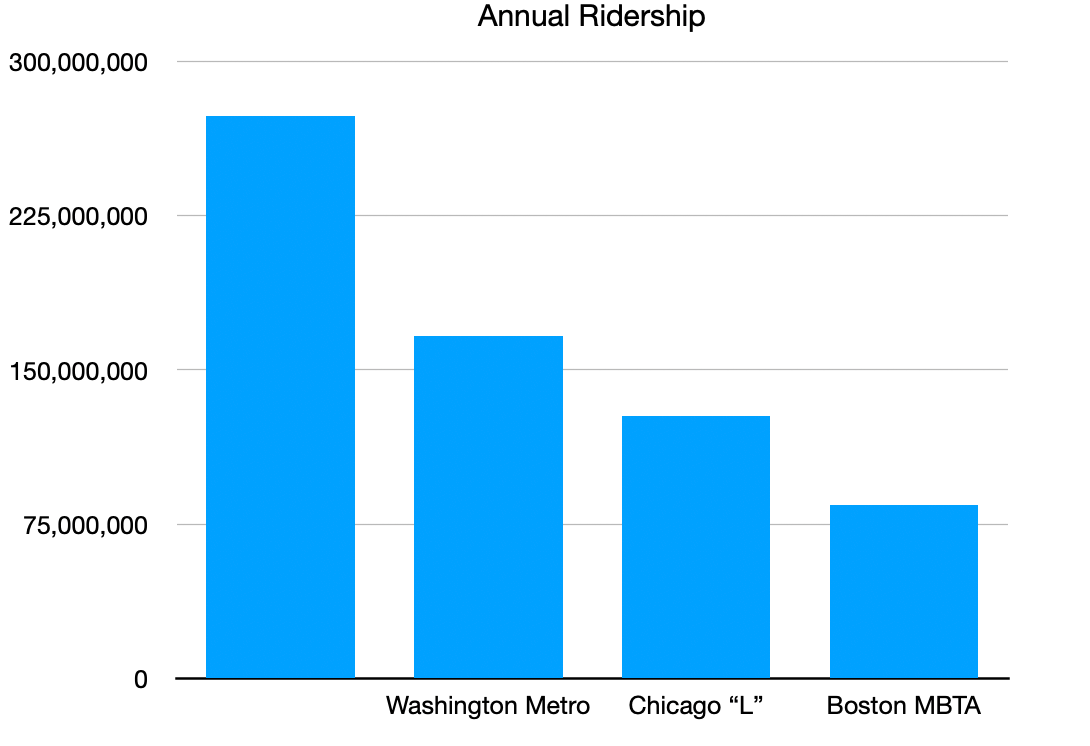
Haha! Just kidding – that first column is just my best estimate (daily figure multiplied by 365) of 2024 ridership for the Lexington Avenue 4/5/6 Subway line. Here’s the full picture (which includes total MTA numbers, so also Metro North, the LIRR, and buses):
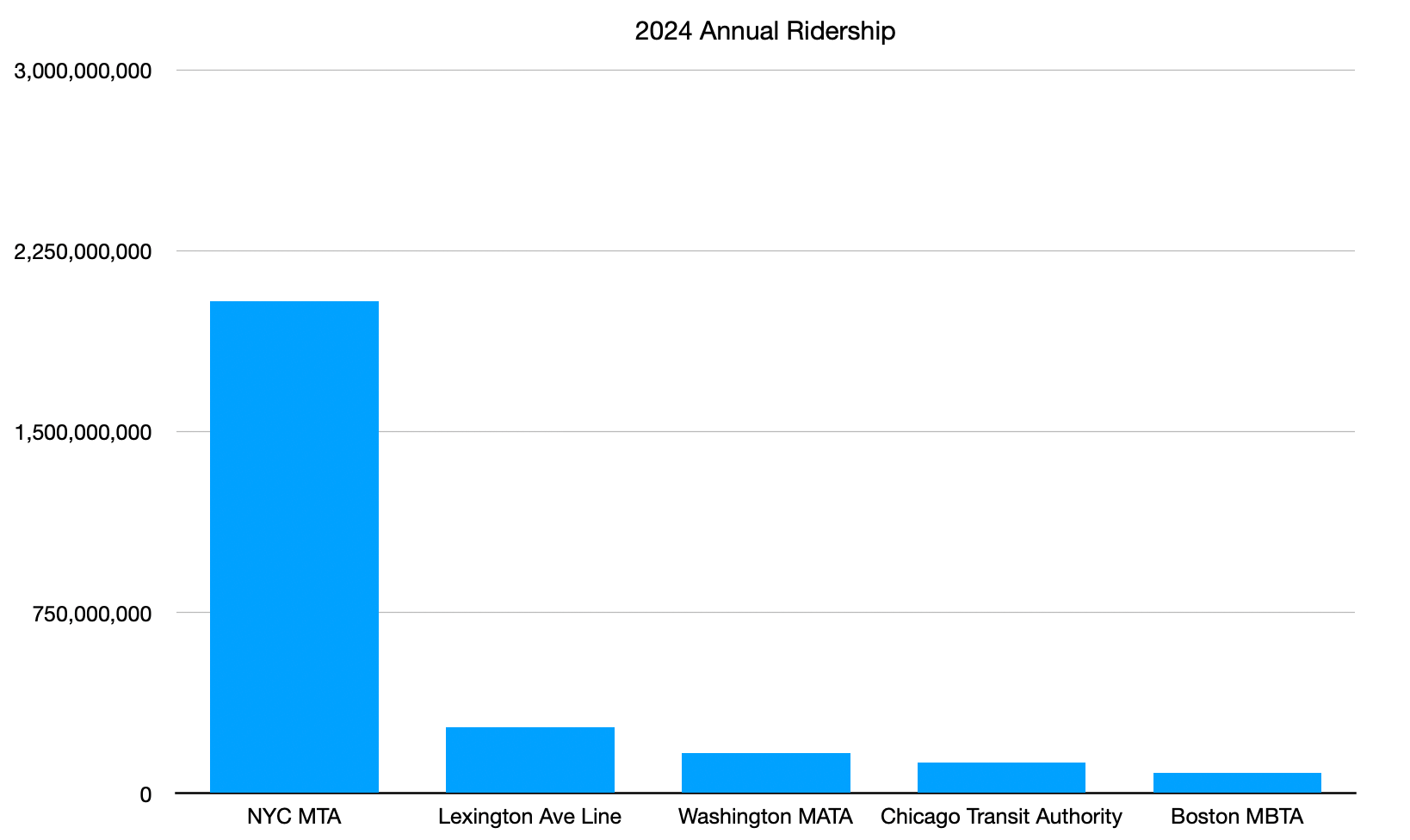
Perhaps it is a pretty monumental achievement just maintaining in good working order a system that’s more than a century old and an order of magnitude busier than any other in the country? And when Federal funding priorities have hamstrung much of our public transit nationally for ~75 years at the same time that Albany’s control over the MTA has done generational harm to the Subway since the days of Robert Moses? Perhaps we should celebrate the remarkable staying power of our world-renowned system more rather than playing into right-wing lies about our cities being broken? And then, of course, we should double down on making our cities even better, but not by starting from the false premise that they don’t work.
Our cities reflect much of what is best about the United States, and no city reflects that more, in my admittedly biased view, than does New York. Friends will attest that I use this framing frequently, but to back-of-the-envelope it: On a scale of human flourishing, where 100 is the maximally imaginable amount given all the existing constraints, New York City is at something like 83. There is plenty of headroom for improvement, especially for those who enjoy fewer of the benefits of living here and suffer more of the harm, but on average, New York delivers a remarkable high baseline quality of living across most metrics; however, a large fraction of the population, including a disproportionate fraction of its most privileged, take the first 80 for granted, and mistakenly believe that we are scoring 3 out of 20, which doesn’t look very good! That is the demoralization peddled by the doomsayers at work – sure, we have clean water, highly reliable electricity, sanitation systems that work unbelievably well given that a large fraction of the population takes zero interest in or responsibility for working within their constraints, by far the best mass transit system in the country, etc, etc, but what has New York City done for me lately?
Living, as I do, between Mumbai/Bombay and New York, it is comparatively easy to keep perspective on the relative excellence of New York City’s public goods and services. Bombay is also a remarkable, electric, intoxicating, and brutal city, but one that is more strained and extreme in almost every respect than is New York. Upon returning to the latter from the former, New York feels quiet, clean, orderly, bizarrely, almost empty.
So why, then, is unearned cynicism – epitomized by the ‘same old shit’ mantra – so widespread amongst New Yorkers? And what are some of the root causes of the social ailment that makes it easier to retreat into pessimism than actually engage with the complex and often contradictory systems and dynamics that shape our city? I think engaging with these questions can help to make clear why a generation of well-meaning if often lightly-informed urbanites have found the simplistic explanations that travel under the YIMBY banner so appealing: There is a technocratic fix. Bureaucracy is the problem. What do we have all these rules for, anyway?! Or more generously, these rules were often created for good reasons, but they’ve been weaponized/captured and need to be overhauled.
In short: It’s the Silicon Valley playbook. X is broken. I have the solution to fix X. What I actually plan to do is privatize/extract monopoly rents by displacing X over time. Now, I don’t think that YIMBYs have some sinister plan to extract monopoly rents from a New York City building boom, but neither is the continuity of (reductive) logic coincidental. This is a Bay Area phenomenon, funded by tech billionaires, and is, unsurprisingly, decidedly geared towards a mechanistic/engineering-style “solution” to various “crises” (I’ve read an enjoyed Dan Wang’s letters for years, but if one more tech person references the lawyerly versus engineering states…), as if it is sufficient to be blandly, apolitically “pro-build” as opposed to taking a position on what to build, where and why, and for whom.
In my experience, the core proponents of these ideas are urban transplants, like myself, who – as a YIMBY-minded friend put it – can be characterized as a “whole generation of very frustrated upwardly mobile renters out there locked out of the life they imagined for themselves - a lot of this is pretty relatively-fortunate people arguing amongst themselves.” To the extent that YIMBYism/Abundance are more grab bags of often unrelated ideas than truly coherent movements, I agree with some of the ideas that get advanced from these positions (there are a lot of opportunities to modernize our city’s bureaucracy!), and disagree, sometimes strongly, with others (witness this whole essay); however, I fault them at a foundational level for getting lost in the equivalent of close reading. They’ve identified, or in many cases, latched on to some perfectly reasonable ideas, but they’ve framed the problem so narrowly that they are missing the whole meaning of the text – maybe honestly, because this particular “text” is a challenging one, or maybe because they’d prefer not to actually engage with it’s meaning: That is, perhaps the housing question has something to do with obscene wealth and income inequality, monopoly power, and what’s happened over the past 50 years as neoliberalism has transformed our political economy and now threatens to give way to neofascism?
But circling back, as I promised I would, to the housing question, the YIMBY premise here is that New York City has not built enough. That’s why housing is so expensive. And we simply need to build, build, build, and that will solve the problem, even if much of what gets built is not actually affordable, and in many cases, is just more ugly luxury condos that – like Le Corbusier’s NYCHA buildings before them – sap the city’s organic vitality and saddle our future with buildings we both won’t want to live with, but may not be able to live without; however, a close look at the housing and population charts with which I started this post might cause one to doubt the core ‘build, build, build’ premise. If population is only roughly 10% higher than it was in the 1960s while housing stock has grown by 30-40% over the same time period, then perhaps building alone may be insufficient to get us out of this predicament?
At this point in the conversation, advocates for the building maximalist position will usually roll out some Econ 101 supply and demand charts and try to bludgeon you with them. Alas, I majored in Economics, don’t have terribly much respect for the field’s dogmas, and certainly don’t think the, ‘It’s supply and demand, stupid’ line of reasoning is sufficient here. Perhaps if there were zero constraints on building in New York (in fact, the most constrained urban environment for construction in the country), then this line of argument might hold – just build towards infinity until the prices come down, no matter that that might destroy a huge amount of existing value, leave homeowners holding underwater mortgages, developers bankrupted, etc (the collapse of the taxi medallion market here is cautionary). As it is, I’d argue that while the city should and will of course continue to build; and in particular, the city should be looking to expand housing and transportation options alike in the broad swathes of the five boroughs that are still basically suburban-like single-family neighborhoods, often with reactionary politics to match; and, of course, lots of smart people in and outside of the city bureaucracy are hard at work in the details of our zoning code, on implementation of the disconcertingly named City of Yes, on instrumentalizing the recently approved ballot measures, etc; there are some additional questions that probably merit consideration.
Of course, a much higher fraction of people are living alone than in the city’s past, and the average household size has decreased. Something like 3-5% of the city’s rental stock is “held for seasonal, recreational, or occasional use” (that is, as pied-a-terres, short-term rentals, or investment properties). Algorithmic collusion, especially through the use of RealPage seems under-explored (though is the subject of current anti-trust action). The dramatic increase in the number of jobs in the city certainly has something to do with housing demand (as highlighted by the comptroller’s office in this report). Sadly, there is a lot of abuse of our rent control and stabilization systems (ask any New Yorker, and they are likely to have a story of someone doing something like living in Florida, but keeping a rent-controlled unit as a New York pad). Plus, ask any broker in one of the city’s hot neighborhoods, and they’ll have stories of offers/applications coming in from across the country and around the world when a place goes on the market (that is, like the competition for Harvard admissions, that for NYC housing is increasingly global). And in the meantime, no real attempts have been made to discourage unit destruction (in particular by the very rich).
In short, a simple supply-and-demand graph does not feel equal to this task, setting aside the fact that New York City’s rental market is, of course, not unitary, but fragmented: NYCHA is one market. Mitchell-Lama is another. Rent-stabilized units have their own dynamics. And then, of course, market-rate units constitute something like half of the city’s roughly 2.5 million rental units. Many of the non-market units are actually accessed via lottery, and once people are inside those sub-markets, they tend to stay within them, and units tend to trade hands internally (just as they often do within a given co-op or condo building, that is, off market). In a best case, this creates non-market opportunities for working class (and other) New Yorkers to access (more) affordable housing. In a worst, it leads to second-class housing status. In practice, the reality is some combination of the two scenarios.
But coming back to the very rich – their excesses of unit destruction, and the excesses of ultra-luxury unit construction that have so transformed the New York skyline in the last decade – they, in turn bring, me to the heart of my position. It might be nice to imagine strictly technocratic fixes to the housing crunch, but in New York City as it actually exists, there are generally sharp tradeoffs and conflicting interests at play with respect to any major development. Sadly, folks who actively identify as YIMBY (and NIMBY for that matter) often seem inclined to revert to name-calling and demonization when they encounter people who disagree with them rather than engage with these tradeoffs and conflicting interests. I see this as primarily a symptom of the shallowness of the intellectual underpinnings of these orientations – the point should be to understand in the richest complexity possible what is actually going on! But that demands a real interest in history and political economy, and sometimes it’s easier to just call someone a racist. Ironically, much of this discourse amounts to internecine warfare centered in Manhattan and a handful of already-quite-dense neighborhoods in Brooklyn and Queens, and rarely encompasses, in a meaningful way the exact neighborhoods were race animus is more likely to play a part in housing/building decisions, and where the opportunities/space to build are most ample.
The argument is often made that the city has been underproducing housing for decades. Often people point as far back as the 1970s in making this argument, but, of course, during that decade the city experienced a fiscal crisis, de facto bankruptcy, and subsequently lost nearly one million residents. City elites at the time were seriously floating proposals to demolish and pave over the entire South Bronx. Decades of post-World War II Federal housing and transportation policies had driven suburbanization, White Flight, and the rise of car culture and its attendant city-destroying infrastructure, while complex transformations of the US and global economies (basically, the early days of neoliberal corporate-led globalization) had hollowed out the industrial base of the city’s economy. Richer, disproportionately White residents left for the suburbs in large numbers, and poorer, disproportionately Black and Brown folks moved to the city in their place just as the bottom was falling out of our municipal social safety net and our (remarkable, thankfully still-partially-extant) network of social democratic institutions (from CUNY, to H&H, to city-run neighborhood childcare facilities and maternal health clinics) was entering into existential, and in some instances terminal decline.
In short, people mostly weren’t talking about the urgent need to build more housing then! And as is well known and extensively referenced in pop culture, a huge amount of housing across the city was abandoned, burned down, etc, etc. Of course, now some of the same people who take a YIMBY stance wax nostalgic for "when you [could] afford an apartment in New York City”, and it is truly wonderful that when Ezra Klein tried to make this intellectually dishonest move in the linked interview with Patti Smith, she instead lectured him about his position on the Elizabeth Street Garden. Anyone who actually lives in and loves Manhattan knows that basically none of us have backyards, and if you are so lucky to have a yard (or an outdoor space of any kind) and someone comes threatening to build on it, you will be up in arms. For most of us here, places like the Elizabeth Street Garden are lifelines – little oases of calm – and the fact that people like Klein are not only eager to destroy the place (which I suspect he, along with the vast majority of Garden “opponents”, has never set foot in), but generally malign the garden’s defenders as reactionary NIMBYs suggests to me merely that they have no idea how popularly loved and widely used the space is. In the abstract, if you just care about a numerical metric – housing starts – then it makes sense. If you’ve ever set foot in the garden on a spring, summer, or fall day, and seen the wildly diverse cross-section of people enjoying it, I think the case gets weaker…
There’s something else of relevance that we can take away from the Klein-Smith interview: Inflation is real! When Patti Smith references a $150 apartment in Greenwich Village in 1967, that’s equivalent to roughly $1,500 of today’s dollars. Still a pretty wide gap from the $7,000 (that she probably made up on the spot, but is directionally correct) she quotes, but not the gobsmacking ~50x difference that her anecdote suggests. She also goes on to say: “There were a lot of abandoned buildings. People squatted, or they would pay cheap rent. And they had cold-water flats. They didn’t have electricity. And these artists slowly started making them better, making them nicer, making them livable. But it was great then. Because you got the rats and the cockroaches and the mold or whatever, but if you were resourceful, you could work with that. You could get a job as a waitress. You could get a job in a bookstore, pay your rent and have at least enough to eat.” Obviously, the city was different then, but analogizing from those realities directly to our own does not yield terribly many useful insights, as much as Klein might like to evoke nostalgia for a gritty, cheaper New York of days gone by (one, of course, where the murder rate was more than 10x what is is today, the air quality was worse, the subways were in a state of profound distress, New York City was still home to the then-largest landfill in the world and struggled mightily with its solid waste, etc, etc) in trying to justify his self-serving agenda. He has a book to sell, after all!
In their seeming lack of interest in the city’s real history and the world’s real contemporary political economy, I fear that this generation of pro-housing zealots (like the Moses-era policymakers and planners who went before them – Moses-era folks who I suspect shared a similar zeal and self-righteousness) will leave the city with a decidedly mixed legacy. In the same way that, for a time, the consensus around “slum clearance” and “urban redevelopment” was ironclad enough – in its alignment of bases of power and economic interests – to permit a cataclysmic reshaping of the city’s urban fabric (the destruction of many intact neighborhoods, very nearly including my own; the carving up of much of the city by expressways; the undermining of our public transit; etc), I fear now that in the name of “affordable housing”, interests as diverse as those represented by our nominally socialist mayor-elect, to those represented by our obviously fascist president are ready to make common cause to reshape New York.
My personal obsession is with what makes healthy, beautiful, joyful, durable, and humane urban places for people to live, and to the extent that this new dispensation offers opportunities to break the stranglehold of car culture, shift our streetscapes back in favor of pedestrians (and bikes, and buses, etc, but with pedestrians always at the center of how we understand the urban form), and to continue the constant evolution of the city in a way that respects the complex factors that make a place great to actually live in, I’ll be a hopeful participant in the process. Even in densely-built-up Lower Manhattan, there remain plenty of opportunities to rationally densify, while still respecting people’s need for light, green space, and sidewalks, not to mention water, sewer, telecom, and power infrastructure, but there are also multiple projects proposed right here in my own neighborhood that strike me as net destructive and sharply out of step with such a coherent and holistic way of thinking about human flourishing. Just because a 60-story tower can be built, doesn’t necessarily mean it should be, but for those to whom housing units are only numbers, often the answer (like the City of) is always: Yes.
To the extent that those yeses are increasingly in favor of building ugly, over-sized structures and lifeless, sterile neighborhoods (like Hudson Yards) in the name of an “affordable housing” fig leaf that masks the exact corporate interests and superrich folks that the YIMBY and Abundance crowd are so afraid of naming or confronting (because, at heart, they are too often, like Klein, just neoliberal apologists in Groucho glasses), I think we’ll be better served to say no. We deserve a better future and an even better New York, and breaking the false NIMBY-YIMBY binary (and ideally burying those terms) in favor of some new and yet-to-be-articulated consensus would be a helpful step in that direction. Probably we can’t call it “The War on the Suburbs”, but that is the direction in which my own thoughts are trending ;)
For now, thanks for reading, and till next week!
Postscript: Incidentally, it now seems that the Adams administration (which is to say, Randy Mastro) of which (and whom) I’m obviously no fan, may broker a last-minute deal for the same developers who had been slated to build on the Elizabeth Street Garden to build equivalent housing on another city-owned lot in the same general vicinity. A vague promise had already been made in that direction, but the developers’ recently threatened lawsuit seems to have potentially forced the issue towards a more concrete settlement.
Also, perhaps I should have led with this, but I’d like to acknowledge – both out of a sense of obligation to lots of hard work people have done and as an olive branch – that the YIMBY tent is a broad one; that many early YIMBY folks are rooted in academic, public sector, and non-profit urbanist circles (I’m looking at you, YIMBY Town!) and bring a nuanced and humane vision to their work; that many folks who might identify (or at least make common cause) with YIMBYism are also very critical of the Bloomberg-era rezonings in New York City that gave us Hudson Yards, but also locked in many downzonings in the suburban parts of the five boroughs; that many of these same big-picture YIMBYs look on “Abundance” with a jaundiced eye (that is, as a branded and atrophied version of what they believe in); and that in particular, for people who are working inside NYC city government (and adjacent to it, say, in the non-profit industrial complex), the terms of the conversation are often very different – characterized on the one hand by lots of institutional depth and historical knowledge (as embodied in this quite readable and illuminating report) and on the other, by the super mundane and often terribly divisive realities around answering, to quote that same friend from above, the questions: “where, how tall, how much parking”?
As for the timing of this post, for those of you who have made it this far, I’ll share that it’s been brewing for some time, but that it feels fitting to put it out there at the time of year when the country celebrates a holiday based on another false/kitsch abundance mythology (here’s the wiki for cornucopia) that was/is used to whitewash settler colonialism and its accompanying horrors.
Great to get out this counter to Abundance, especially as it may be too focused on a place like NYC. But let's get down to brass tacks on this. Did you vote for or against the charter amendments on zoning? I still have a problem with a single council person having the power to veto a rezoning that could benefit the city as a whole. And it didn't look like the Council was ever going to change a practice as opposed to something that was required by law. As just one example, I wasn't against the Industry City rezoning (did you see "Emergent City"), and think the City would be better off if this project had been built. Not paradise, just a little better.